Veerhe
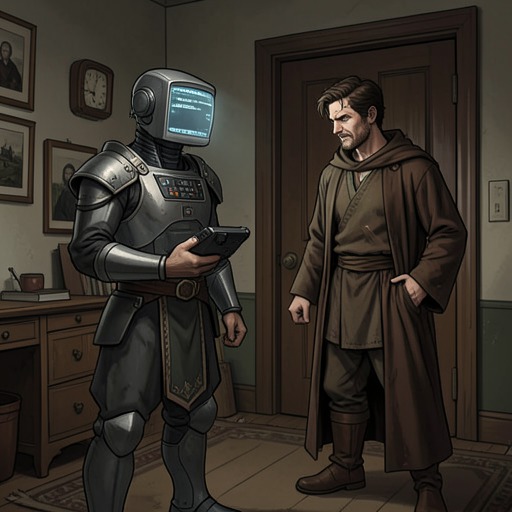
The Robot Who Looked Like MeVeerhe is the Chief of the Office of Future Projections on Loris and the nearest thing the planet has to a ruler. He does not govern by issuing orders: his authority rests on forecasts, including the prediction that conflict with Earth is inevitable because humans will pursue dominance more relentlessly than the Lorians. When Johnny Bezique comes to confront him, Veerhe answers the threat not with force or evasion but with an offer to put Johnny in charge.
Office and Political Setting
Veerhe’s title suggests an executive authority, but his office occupies an unusual place in Lorian public life. Loris has no discernible conventional government in the human sense; the people’s collective mind is described as calm and thoughtful, and government action closely reflects public desire. The little government that exists mostly governs by not governing. Veerhe is its closest equivalent to a ruler, yet his stated function is to issue economic, social, and scientific forecasts from time to time, not to command the population.
That distinction matters to his role in the story. Veerhe is important enough for Johnny to identify him as the person to confront, but the office does not make him a king whose will can simply be imposed on the planet. His influence is connected to the act of projection: he describes where events are likely to lead, and Lorian political choices follow from what that forecast makes visible. The office therefore places prediction where a more coercive society might place executive power.
The account of Loris gives this arrangement a concrete setting. Its capital, Athisse, is filled with public buildings, bazaars, parks, and other shared amenities; food, clothing, housing, and entertainment are free, and doors respond to mental command rather than locks. The society is presented as materially abundant and politically mild. Against that background, Veerhe’s work is not portrayed as the management of scarcity or enforcement of ordinary obedience. His decisive task is to interpret a danger that arises from contact with a more aggressive political culture.
The Encounter with Johnny Bezique
Johnny arrives with a coercive plan: he intends to find the local ruler and threaten to kill him unless the people listen to reason. That approach has a basic problem, since Loris has no ruler in the familiar sense. Johnny therefore turns to the nearest official figure, reasoning that a prominent person such as Veerhe might be guarded. After receiving directions from a friendly native, he gets within four blocks of the Office of Future Projections before a posse of twenty monitors stops him.
The monitors demand that Johnny surrender, but appear uncertain about carrying out an arrest; the narration suggests that this peaceful society’s officers may never have had to perform the job before. When Johnny continues into the office, the special monitors do not shoot. He hears them arguing as he walks down the corridors, then comes face to face with Veerhe. The sequence places Veerhe at the end of a confrontation that Lorian institutions are poorly equipped to handle through force, and it makes his welcome a sharp contrast to Johnny’s expectation of a guarded official.
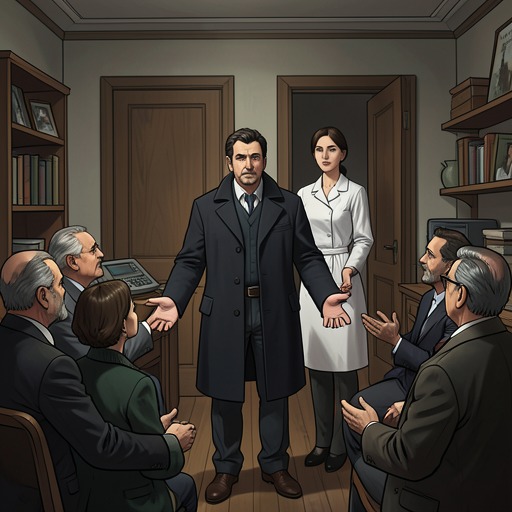
Veerhe is described as a calm, small man with an aging pixie face. He greets Johnny and offers him a seat, then says that he has completed a projection concerning Earth and Loris. Johnny tries to set aside the forecast and make his own demands, but Veerhe insists that the projection is relevant. His composure is not a claim that the danger is trivial: he presents a grave conclusion without adopting Johnny’s threatening manner.
Forecast of Conflict
Veerhe explains that his office has extrapolated the racial characteristics of Earth’s people and matched them against those of the Lorians. The forecast is that the two peoples will conflict over preeminence. Veerhe locates the drive for that contest on the human side, not the Lorian side: Earth people, he says, will not rest until they rule the Lorians or are ruled by them. In his account, the outcome follows from Earth’s level of civilization and the human desire to prevail.
Johnny does not need the office’s title or methods to recognize the same danger. He agrees that humans want victory more intensely than the Lorians do, and describes the imbalance plainly: the Lorians follow rules even in life-and-death contests, whereas Terrans will stop at nothing to win. The exchange gives Veerhe’s forecast an unusual confirmation. Rather than merely predicting an external opponent, it is borne out by the opponent’s own admission about the difference between the two societies.
Veerhe’s conclusion is not that the Lorians should prepare to outfight Earth. He says that his people have decided it is reasonable to save time and trouble by putting Johnny in charge of them immediately. The forecast thus becomes a political proposal: if conflict is inevitable because humans will seek rule, Loris can accept a human ruler before that struggle takes place. Veerhe does not present the decision as personal surrender alone; he attributes it to what the Lorians have concluded after considering the projection.
Transfer of Authority and Significance
Veerhe asks Johnny whether he will rule the Lorians. Johnny is surprised, questions whether the offer can be serious, and says that he is not qualified, before accepting. His acceptance is conditional in spirit on his own judgment that he likes the Lorians and will do a good job, while Veerhe’s answer is that they will be easy to manage so long as Johnny’s orders remain within their psychological capabilities. Veerhe therefore frames the transfer as workable but not limitless: the new ruler’s authority must remain compatible with the people he is to govern.
The episode defines Veerhe through a contrast between prediction and command. He holds the closest position to political leadership on Loris, yet does not issue orders; when faced with a potentially violent outsider, he uses a forecast to explain the stakes and proposes accommodation rather than resistance. His response also exposes the limits of a peaceful system when confronted with a society whose competitive impulse, as Johnny confirms, may overwhelm rule-following. Veerhe’s defining action is to turn that asymmetry into a voluntary handover, making the Office of Future Projections the unlikely starting point for Johnny Bezique’s rule.